
Week 4 Insight
As we go through chunks of Scripture, I'll be posting the study guide on Friday mornings as usual. I will also be adding in a midweek insight occasionally. These posts will be elaborating on the study guide and sharing my insights and application of the text.
1 John 1:1-4 is the kind of passage that I typically coast over so I can get to the parts that are more plain-speak. This is a safe place to admit that right? But ever since I started going deeper with my studying, passages which I don't understand right away are now exciting to me. It's like someone literally drew arrows and made a huge sign that says "Buried Treasure." I've come to love these passages because I KNOW I will learn something since I start off with such little understanding of it.
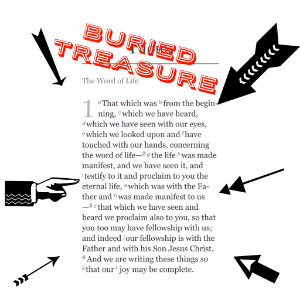
Have you ever vouched for someone? Maybe you've been listed as a reference for a friend's new job or you've had to defend a loved one or maybe you are trying to set up a friend on a blind date. That same urgency of "I KNOW them" that comes from your gut....that's what John is bringing to us here. He is coming from this place that's way beyond "Yea I know who he is" this is John talking with a sense of urgency, conviction--this "No...like I really KNOW him" place.
This first passage in 1st John is all about the answering the question "Who is Jesus?" and then only and only then answering the question of what that means for us. This passage, 1 John 1:1-4, speaks to three aspects of his identity (out of like...a bajillion) 1. He is physically real (v1-3), 2. He is relationally present (v3-4), and 3. Jesus is the light that leads to eternal life (v 2 & 5 I know it's not really fair that I just jumped ahead a little). These three qualities are elaborated upon with three major themes: Seen, Proclaim, and Fellowship.
Seen.
John walks through the physical, tangible, "realness" of Jesus first. He says that they have heard, seen with their eyes, looked upon and touched with their hands-- that's three out of the five senses (and it would be weird to include smell and taste, am I right?). This is kind of the most elementary aspect of Jesus' identity, and yet for me the most convicting. As a person who has grown up in and around church and had a personal relationship with Christ for a while....reading this made me realize how much I keep Jesus in a fairytale box. I know with my head that he was and is still very real and very alive. But I sometimes catch myself living like Jesus is a historical figure or a folklore hero. This passage smacks me in the face cause it says "Dude, get a grip on reality he is as real as you are right now." God became incarnate in Jesus. This means that Jesus is the bodily, tangible, flesh who is also completely and fully God. If you have heard or read the verse "And the Word became flesh and dwelt among us, and we have seen his glory, glory as of the only Son from the Father, full of grace and truth." (John 1:14), then you have heard about this idea before. Incarnation means that "The Word" (Jesus) took on flesh, but being fully God was made manifest so that we could have eternal life (v2 &3). Gary M. Burge in his commentary on The Letters of John (1st, 2nd, and 3rd John) explains that "Thus in verse 1 John writes that this word was 'from the beginning'....This does not refer necessarily to the beginning of Jesus' life on earth (although some have argued this). It instead sets out the marvelous tension of Christian thought: He who existed from limitless eternity has entered time and space and taken up residence here on earth" (Burge, 53). John repeats this testimony of their tangible experience with Christ several times. There is no getting past it... Jesus is alive. Jesus is real. Jesus is God incarnate. Jesus is eternal.
Proclaim.
We won't stop. We won't stop because we've seen it. We're changed by it. We won't stop because He is the light of man. We'll testify that He is the way and the truth and the life. We'll spend our life on it because this is the way to eternal life. So we'll testify to it and we'll proclaim it. --This is the way I want to carry John's torch. This steady focus on sharing Christ is the example I want to follow. It doesn't matter whether John is speaking to churches full of believers or a crowd or one lost person. His resolve is the same. He proclaims the truth of God's word and the testimony of Jesus Christ to all people. I love the way that John R. W. Stott puts it, that the Gospel of Jesus Christ "was proclaimed, not monopolized" (Stott, 61) by the apostles.
Fellowship.
Three things here. 1. "So that you too may have fellowship with us": you and me and our people, horizontally sharing community 2. "our fellowship is with the Father and with his Son Jesus Christ": my community is vertical with God, which is the binding pillar in my horizontal community with other believers 3. "that our joy may be complete": our joy together. I've said all this so that you would know and believe and join me side by side as we bind ourselves to the God who is above all in vertical community that we would have complete joy together in this community through Christ Jesus. This wasn't the apostles saying "Hey do this so you can make us happy." This is John saying, believe this so that my joy and your joy will be the same joy which is complete and overflowing.
And so I'll just end by saying to you, let's do this thing. Let's live it out. Let's breathe it in while we change diapers and breathe it out while we drive to work. Let's be fueled by furthering the kingdom in conversations while we grab our mail. Let's proclaim it with everything we are even when--especially when it makes us feel out of place. Let's live well and deeply and show the world (even when the "world" is a world of toddlers at our feet insisting on a 4 o'clock snack time) that the grace of Jesus is the light and the way.
Burge, Gary M. "Letters of John." The NIV Application Commentary: Fro Biblical Text ... to Contemporary Life. Grand Rapids, MI: Zondervan, 1996. 53. Print.
Stott, John R. W. "The Authoritative Proclamation." Tyndale New Testament Commentaries. Grand Rapids: Wm. B. Eerdmans Comapny, 1976. 61. Print.